
The "Mystery" Fever Explained: A Parent’s Guide to the 2025 Scrub Typhus Outbreak
Expert advice on identifying the tell-tale "cigarette burn" mark, symptoms to watch, and how to keep your little ones safe.
12/8/20253 min read
Introduction: Why are we talking about this now?
As a medical writer who has tracked pediatric health trends in India for over a decade, I’ve seen many seasonal waves. But the recent surge in Scrub Typhus cases in late 2025—particularly in Andhra Pradesh and neighboring southern states—requires our immediate attention.
Reports from districts like Chittoor and Visakhapatnam indicate a rising number of cases, many affecting children. While the name sounds intimidating, the good news is that Scrub Typhus is highly treatable if caught early. The danger lies in missing the signs because they look so much like a regular viral fever or Dengue.
This guide is designed to help you, the "Ybaby" parent, cut through the panic and focus on identification and prevention.
What is Scrub Typhus?
Scrub Typhus is a bacterial infection caused by Orientia tsutsugamushi. Unlike the flu, it doesn't spread from person to person (so your child can’t catch it from a classmate). Instead, it is transmitted by the bite of a microscopic chigger mite (larval mite).
These mites live in bushes, low-lying vegetation, and grass—places where children love to play.
The #1 Clue: Identifying the "Eschar"
The most distinctive sign of Scrub Typhus is a skin lesion called an eschar. In my 15 years of experience, I cannot stress this enough: Finding this mark can save your child from unnecessary complications.
What does an Eschar look like?
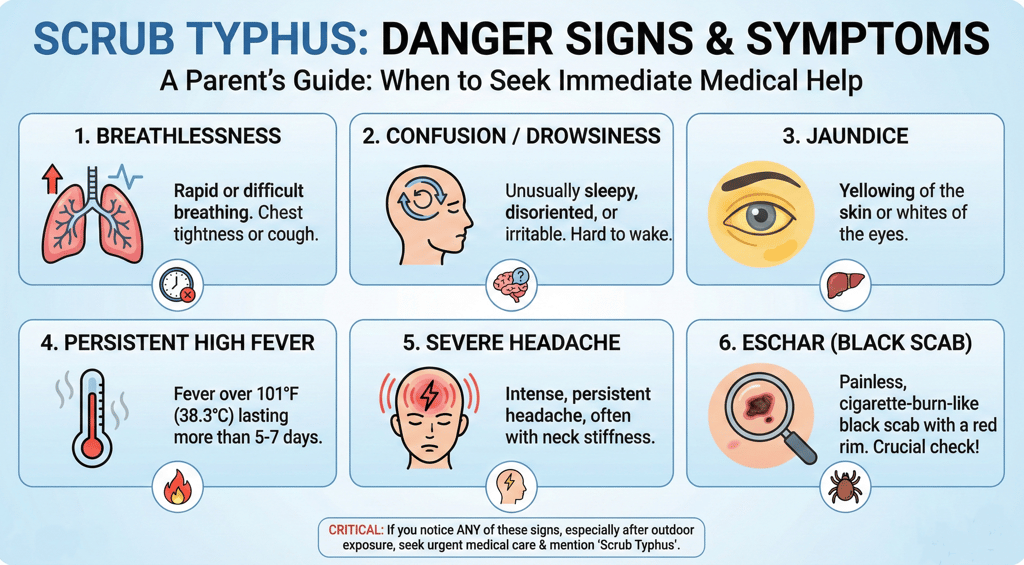
Appearance: It looks like a painless cigarette burn. A small, black scab surrounded by a red, angry-looking ring (inflammation).
Size: Usually small, about 5mm to 1cm.
Sensation: It is often painless and does not itch, which is why children rarely complain about it.
Where to look? (The "Hidden" Spots)
Mites prefer warm, moist, and covered areas of the skin. If your child has an unexplained fever, do a full-body check, paying close attention to:
Groin and genital area
Armpits (Axilla)
Behind the ears
Neck folds
Waistline (where underwear elastic sits)
Expert Note: Not every child gets an eschar (or it might be missed). If you don’t see one but the fever persists, do not rule out Scrub Typhus.
Symptoms: When to Call the Doctor
The incubation period is usually 6 to 21 days after the bite. Symptoms can appear suddenly.
Common Symptoms in Children:
High Grade Fever: often >101°F, lasting more than 5-7 days.
Chills and Shivering: Similar to malaria.
Severe Headache: Older children may complain of intense head pain.
Swollen Lymph Nodes: Lumps in the neck, armpit, or groin.
Red Rash: A flat, red rash may appear on the body towards the end of the first week.
Body Aches: The child may seem unusually lethargic or refuse to walk due to muscle pain.
Danger Signs (Red Flags):
Breathlessness or rapid breathing (sign of lung involvement).
Confusion or extreme drowsiness.
Jaundice (yellowing of eyes).
Precautions: Protecting Your "Ybaby"
Prevention is focused on avoiding mite bites. You don't need to lock your children indoors, but you should take these precautions, especially if you live in or visit areas with vegetation (parks, fields, rural areas).
Dress Smart:
When playing outdoors (especially in grassy areas), have your child wear full-sleeved shirts and long trousers.
Tuck pants into socks to prevent mites from crawling up the legs.
Insect Repellents:
Use child-safe mosquito repellents on exposed skin. Repellents containing DEET or Picaridin are effective against chigger mites.
Post-Play Hygiene:
The "Scrub" Bath: Scrubbing the skin with soap and water after playing outdoors can actually wash off mites before they attach or transmit the bacteria.
Check their clothes. Wash play clothes in hot water if possible.
Environment:
Avoid drying clothes on bushes or low fences, as mites can transfer onto the fabric.
Keep the grass in your garden trimmed short.
Diagnosis & Treatment
If you suspect Scrub Typhus, visit your pediatrician immediately.
Diagnosis: Doctors may use blood tests (like ELISA or IgM) to confirm the infection.
Treatment: The standard treatment is simple antibiotics like Doxycycline or Azithromycin (safe for children when prescribed by a doctor).
Outcome: With timely antibiotics, fever usually subsides within 24-48 hours. Delays can lead to complications, so early suspicion is key.
A Note from Ybaby: Parenting is about being prepared, not scared. This outbreak is manageable. Keep an eye out for that "black scab," and if your child has a stubborn fever, ask your doctor: "Could this be Scrub Typhus?"