

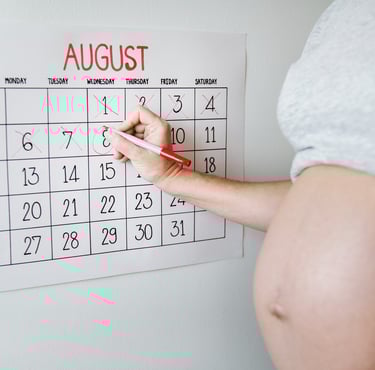
What Is EDD (Estimated Delivery Date)?
Explain what EDD means, medical relevance, and why accuracy matters.
How Our EDD Calculator Works
Cover:
LMP method
Conception method
Methods Doctors Use to Calculate EDD
Naegele’s Rule
Ultrasound crown-rump length (CRL)
IVF cycle dates
Adjusted due dates
Why Estimated Delivery Date Can Change
Explain: cycle variations, irregular periods, late ovulation, first-trimester scans.
What Affects Your Baby’s Actual Delivery Date
Preterm labor, full-term window (37–42 weeks), maternal health, etc.
FAQs
1. What is an Estimated Delivery Date (EDD)?
The Estimated Delivery Date (EDD) is the predicted date when your baby is most likely to be born. It is usually calculated as 40 weeks from the first day of your last menstrual period (LMP) or using an early ultrasound.
2. How is the EDD calculated?
Doctors commonly use:
LMP-based calculation (Naegele’s Rule)
Early pregnancy ultrasound
Conception date or IVF transfer date
Embryo age for IVF pregnancies
Our calculator integrates all these methods.
3. Is the EDD always accurate?
No. The EDD is only an estimate. Only about 4–5% of babies are born exactly on their due date. Most births happen between 37 and 42 weeks.
4. Why does my due date change after an ultrasound?
Doctors may revise your EDD if:
The baby’s measurements don’t match your LMP
You have irregular cycles
You ovulated late
You don’t remember your LMP accurately
Ultrasound in the first trimester is the most reliable method.
5. Can I calculate my due date without knowing my LMP?
Yes. You can use:
Ultrasound-based EDD
Date of embryo transfer (IVF)
Conception date (if known)
Our calculator supports all these options.
6. Why is pregnancy counted from LMP and not conception?
Because most women don’t know their exact ovulation or conception day. The LMP method provides a consistent medical standard to track pregnancy worldwide.
7. What affects my baby’s actual delivery date?
Factors include:
Cycle length variations
Late ovulation
Health conditions
Placenta issues
Multiple pregnancy (twins/triplets)
First pregnancy vs. subsequent pregnancies
8. How does IVF change EDD calculation?
In IVF pregnancies:
Fresh embryos are considered 3 or 5 days old
Frozen embryo transfers use the embryo age at freezing
The due date is then calculated from the embryo’s exact developmental age.
9. Can my due date be wrong?
Yes—especially if:
You have irregular periods
You ovulated late
Your first ultrasound happened after 12–13 weeks
In those cases, doctors rely more on early scans than LMP.
10. Should I rely on an online EDD calculator or visit a doctor?
Online calculators give a good estimate, but a doctor’s ultrasound provides the most accurate due date. Always confirm your EDD during your first antenatal visit.
11. Why is my EDD different in different apps?
Different apps may use:
Slightly different formulas
Regional norms
Different assumptions about cycle length
Our calculator uses medical-grade guidelines for India.
12. Can I change my EDD myself?
No. Adjusting the EDD should only be done by a qualified doctor after reviewing ultrasound measurements and clinical history.