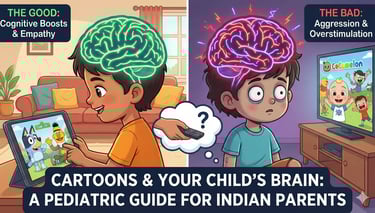
The Cartoon Dilemma: How TV Shapes Your Child’s Brain (A Pediatric Guide)
Is TV helping or harming your child? Discover the developmental impact of cartoons like Bluey vs. Cocomelon. Get expert screen time tips and a safe viewing guide for Indian parents.
12/12/20253 min read

Introduction: The "Digital Babysitter"
It is a familiar scene in millions of Indian households: a bowl of dal-chawal in front of a toddler, and a smartphone or TV screen playing colorful animations in front of their eyes. For exhausted parents, cartoons are often a necessary break—a "digital babysitter" that allows for 20 minutes of peace, a shower, or a finished meal.
But as a parent, you likely harbor a quiet worry: Is this harming my child?
The answer is not a simple "yes" or "no." As a healthcare content specialist, I have analyzed guidelines from the Indian Academy of Pediatrics (IAP) and current psychological research to help you navigate the colorful, chaotic world of children’s television.
The Science: "Monkey See, Monkey Do"
Children, especially those under the age of 5, have highly "plastic" brains. They are learning machines. Their primary mode of learning is observational learning (often called the Social Learning Theory).
If a character on screen solves a problem by hitting, the child learns that aggression is a tool. If a character solves a problem by asking for help, the child learns negotiation.
The Reality Gap: Toddlers (under 3) struggle to distinguish between fantasy and reality. When Chhota Bheem fights a villain, a 3-year-old doesn't see "good vs. evil"; they just see "hitting solves problems."
The Good, The Bad, and The Overstimulated
✅ The Good: Cognitive & Social Boosts
When curated correctly, cartoons can be powerful educational tools.
Language Explosion: Shows like Sesame Street (or the Indian version Galli Galli Sim Sim) are proven to expand vocabulary.
Empathy Building: Characters that express clear emotions help children name their own feelings.
Cultural Connection: Indian animation can introduce mythology and folklore, keeping children connected to their roots.
❌ The Bad: Aggression & Stereotypes
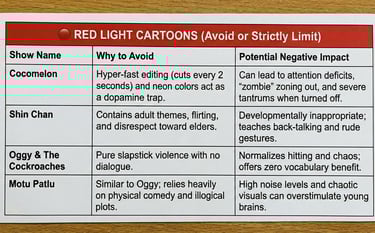
Desensitization to Violence: Constant slapstick violence (hitting, falling, hammering) can lower a child's empathy for pain in real life.
Poor Role Models: Many cartoons rely on "bratty" behavior for comedy (e.g., sticking tongues out, mocking parents), which children immediately mimic.
The "Pester Power": Commercials or product placements in cartoons aggressively target children, leading to tantrums for specific toys or junk food.
⚠️ The Ugly: Hyper-Stimulation
This is a modern medical concern. Shows with rapid-fire scene changes (cutting every 1-2 seconds) and high-contrast colors can overload a young child’s sensory system.
The Result: "Zombie mode" while watching, followed by a meltdown (crash) when the TV is turned off. This is effectively a dopamine withdrawal.
Show Ratings: What to Watch & What to Skip
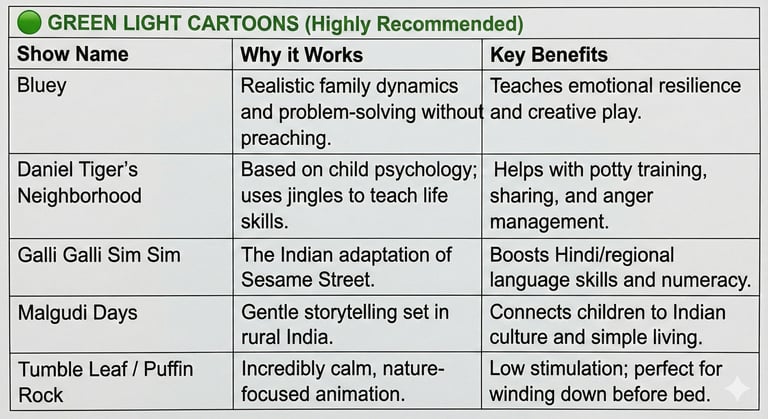
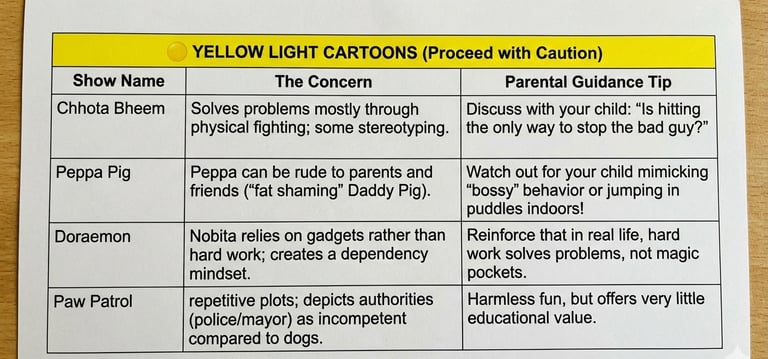
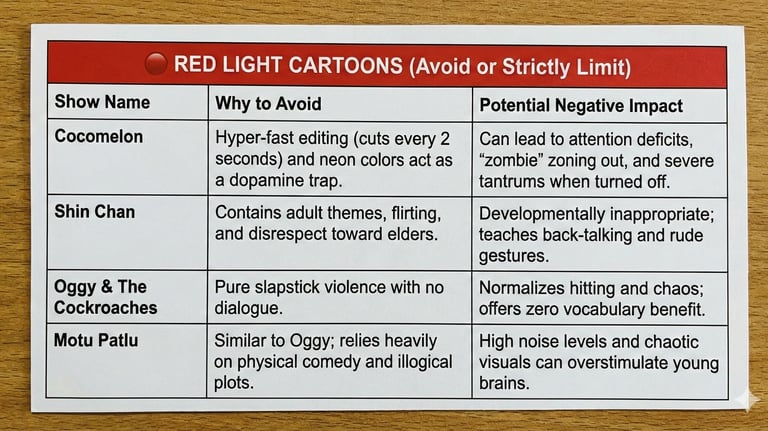
Based on pacing, values, and psychological impact, here is a breakdown of popular shows in the Indian market.
🟢 GREEN LIGHT (Excellent for Development)
🟡 YELLOW LIGHT (Watch with Caution/Co-view)
🔴 RED LIGHT (Avoid or Strictly Limit)
Medical Guidelines: The Prescription
According to the Indian Academy of Pediatrics (IAP) and global standards, here are the official screen time limits:
Children < 2 Years: Zero screen time (except for occasional video calls with family). Their brains need 3D interaction, not 2D screens.
Ages 2–5 Years: Max 1 hour per day. This should be high-quality, educational content, ideally watched with a parent.
Ages 5+ Years: Consistent limits. Ensure screens don't displace sleep, physical play, or homework.
Your Action Plan: The "3-C" Strategy
You don't have to ban TV, but you must manage it. Use the 3-C approach:
Curation (Content is King):
Stop "Auto-Play" on YouTube. The algorithm will eventually lead your child to weird or inappropriate content.
Curate a specific playlist of "Green Light" shows.
Co-Viewing (Be Present):
Watch with them. If a character hits someone, pause and ask: "Was that nice? What should he have done instead?" This turns passive zoning-out into active learning.
Clock It (Time Limits):
Use a timer. When the timer goes off, the screen goes off. Expect a tantrum the first few times, but be consistent.
The 20-20-20 Rule: To protect eyes, every 20 minutes, have them look at something 20 feet away for 20 seconds.
Final Thought
Cartoons aren't the enemy—unguided consumption is. A child who watches 30 minutes of Bluey and talks about it with their mom is having a vastly different developmental experience than a child left alone with YouTube Shorts for two hours. Be the pilot, not just the passenger, in your child’s viewing journey.
Disclaimer: This content is for informational purposes only and does not constitute medical advice. Consult your pediatrician for concerns regarding your child's development.